Showing posts with label Jose Beltran. Show all posts

Thursday, September 22, 2016

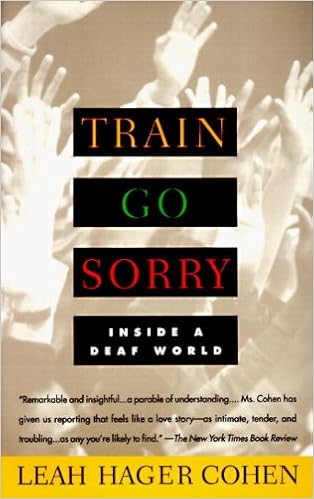
Train Go Sorry by Leah Hager Cohen

Posted by Anonymous

Reviewed by: José Beltrán

What I Read: Train Go Sorry: Inside a Deaf World by Leah Hager Cohen

Find It @YCLD: Here!

What It's About: Leah was one of the first hearing children who attended the Lexington School for the Deaf in Queens, New York. She felt she had missed the boat to belonging to the deaf. “I’m so hearing,” she lamented. She so wanted to share in their intimacy. Her parents were engrossed in the school: her Jewish father, Oscar, was principal then director and her Protestant mother was a nursery school teacher. Oscar was a CODA (hearing child of deaf adults).

Leah’s family was also a cultural microcosm of religions, races, hearing, and deaf. Her parents were hearing. Her grandparents Sam and Fanny Cohen were deaf. Had Sam’s deafness been detected at Ellis Island, he would not have been allowed to enter the USA. In 1916 they were called Deaf-Mutes, more familiarly Deaf Dumb. The insensitivity of the past is erased as cultures and societies evolve. The personal tragedy of the Cohen family was that the hospital did not provide an interpreter to Sam or his wife Fanny, or allow their bicultural son to communicate with the doctors after Sam’s heart attack.

What I Thought: “Train go sorry” is a Deaf idiom for “missing the boat, missed connections, lost opportunities”. This book is an impassioned plea for the civil rights of Deaf culture. The Deaf should be the ones to decide what is best for them instead of being expected to conform to hearing culture or communicating like hearing people. About 1 in 20 Americans are Deaf or hard of hearing (deaf). There are over 4 million Deaf people in the United States. Sign language is used by about 70 million people worldwide and is the fourth most used language. ASL is accepted by many schools for fulfillment of foreign language requirements.

Still many Deaf people feel isolated! Deaf Melissa testified that she had first attended a hearing school then transferred to a deaf school. At the hearing school she was isolated, shy, and passive, unable to participate. In the deaf school, her participation soared as cheerleader, peer counselor, choreographer, and as the lead in the Deaf school play.

The Deaf like all people yearn for connection. But they find themselves confined to the small world of those who know ASL. You can make the world of the Deaf larger by learning ASL. The Yuma County Library District have books and DVDs for learning ASL. Look at the eyes! Use peripheral vision for the hands. Join a Deaf Club!

Readalikes: Deaf Again, Children of a Lesser God, The Mask of Benevolence: Disabling the Deaf Community, When the Mind Hears

Or look this book up on NoveList!

Thursday, April 14, 2016

Verbal Judo by George J. Thompson, Ph. D & Jerry B. Jenkins

Posted by Anonymous


Reviewed by: José Beltrán

What I Read: Verbal Judo: The Gentle Art of Persuasion by George J. Thompson, Ph.D & Jerry B. Jenkins

Find It @YCLD: Here!

What It's About: The power of the word! Effective communication is so much more than what you say. The messenger is more likely to be killed for the way the message is delivered than for the actual message. The tone of your voice, your pace, pitch and body language, your sincerity, and your caring matters. Angry words spoken in haste cause wounds that fester and may never heal. You can avoid becoming part of the problem! Judo means the gentle way. Do not resist, keep calm, and redirect the negative energy. The purpose of Verbal Judo (martial art of mind and mouth) is to help you build and maintain your relationships with your family, friends and strangers.

What I Thought: This book demonstrates how to be a communications warrior. It shows how to redirect negative energy in order to keep you calm by deflecting verbal abuse through giving empathy. “Look good, sound good, or no good.” This book is most definitely not about humiliating and putting people down.

Readalikes: Tongue Fu! How to Deflect, Disarm, and Defuse Any Verbal Conflict. The Gentle Art of Verbal Self-Defense at Work

Or look this book up on NoveList!

Thursday, March 3, 2016

Healthy at 100 by John Robbins

Posted by Anonymous


Reviewed by: José Beltrán

What I Read: Healthy at 100: The Scientifically Proven Secrets of the World's Healthiest and Long-Lived Peoples by John Robbins

Find It @YCLD: Here!

What It's About: Old age should be the crown of a successful life. Yet people are getting sicker sooner and are remaining chronically sick. We prolong our dying and struggle with pain, loneliness, disability and depression? How can we promote our own healthy aging? What choices can we make to avoid bitterness and increase our health span? This book says yes we can live to a ripe old age without losing our physical, mental health, and vigor. From Abkhazia in the Caucasus south of Russia, where age is beauty, and Vilcabamba in the Andes of South America, where laughter is the greatest medicine, the Hunza in Central Asia, where dance is ageless, and finally the southern Japanese islands of Okinawa, the Japanese Hawaii.

What I Thought: This book is about finding the Fountain of Youth. The recommended practices in this book help us regenerate and rejuvenate instead of degenerate. In this book, Robbins (son of owner of Baskin-Robbins) shows us how our diet and exercise are critical to health and healing. Robbins explains how body and mind can interact to help us. Socializing is key to our purpose and joie de vivre! Our spirit finds the fountain of youth in the quality of love, wisdom, and courage we have lived. Robbins writes that the two most important dates in our lives are the day we are born and the day we know why we were born. Youth is a state of mind not a time of life!

Readalikes: The Hundred-Year Lie by Randall Fitzgerald; Counterclockwise by Lauren Kessler

Or look this book up on NoveList!

Thursday, January 21, 2016

The Black Count by Tom Reiss

Posted by Anonymous


Reviewed by: José Beltrán

What I Read: The Black Count: Glory, Revolution, Betrayal, and the Real Count of Monte Cristo by Tom Reiss

Find It @YCLD: Here!


What It's About: Tom Reiss, winner of the 2013 Pulitzer Prize for biography, narrates a biography of the father of famous novelist Alexandre Dumas. Alexandre Dumas the novelist based his novels on the swashbuckling adventures of his own father, French General Alexandre Dumas. Dumas the writer wrote in his memoir “You see, Father, I haven’t forgotten any of the memories that; you told me to keep…Your memory has lived in me like a sacred lamp, illuminating everything and everyone you ever touched…” Dumas the soldier was the hero at Mauld, Mont Cenis, Mantua, the Horatio Cocles of the Bridge of Brien, and Cairo. Dumas the soldier was born the Haitian black slave son of the beautiful black slave Marie Cessette and the ne'er-do-well  fugitive white French Norman noble Alexandre Antoine Davy Marquis de la Pailleterie(1714). Napoleon was the man behind Edmond Dantès’s suffering.

What I Thought: Reiss gives a front row seat to the events leading to the French Revolution and the revolution itself. The book goes to great detail explaining 1700 French society culture, especially slavery, the customs, and the players and the laws, especially Le Code Noir, the French codification of colonial slavery (1685) by the Ancien Régime. Mulattos were repressed as shown by the insolence related in the encounter and incident at Nicolet’s. D’Artagnan of the three musketeers represents the father of Alexandre Dumas as not fitting in. 

Dumas the soldier enlisted as a common soldier private, dragoon (light cavalry) and fully embodied the ideals of the French Revolution as an ardent republican, especially equality, bravery, leadership and above all his swordsmanship. Imprisoned, poisoned by the Inquisition, and later sidelined by Napoleon Bonaparte’s jealousy taking credit for the work of others such as Dumas’s victory at Mantua, Dumas was appointed to head the cavalry without mounts in the invasion of Egypt (1798) against the Mamelukes. Here Dantes witnessed slavery firsthand as Arab traders brought slaves from Ethiopia. Returning to Europe on the Belle Maltaise in 1799, Dumas almost drowned and, landing in Naples, was quarantined. Dantes finds himself the prisoner of the Holy Faith Army under Cardinal Fabrizio Ruffo, which massacred Jews, liberals, and republicans. The Cardinal joined with Turk Ottomans, British, and Russian forces to purge Naples of any French influence. This 2 year imprisonment in the fortress of Taranto became the basis for The Count of Monte Cristo.

As general in chief of the French Army in Italy, Dumas the soldier clashed with Napoleon, who thought himself Caesar, on the treatment of civilians. Napoleon finally achieved his dream: he was declared dictator in 1799 with the money and support of slavers, and then emperor in 1804. Napoleon reinstated slavery and forbade mixed marriage. Dumas the author was denied a secondary education, and admission to any military school or civilian college. His mother died at the age of 69, never having received a sou (penny) of the pension that Dumas the General was denied. She did live long enough to see Dumas the writer, her son achieve international fame and fortune. Her grandson became Dumas the playwright.

Readalikes: The Orientalist, Twelve Secrets in the Caucasus

Or look this book up on NoveList!

Wednesday, November 25, 2015

Brain Maker by David Perlmutter, M.D.

Posted by Anonymous


Reviewed by: José Beltrán

What I Read: Brain Maker: The Power of Gut Microbes to Heal and Protect Your Brain - for Life by David Perlmutter, M.D. with Kristin Loburg

Find It @YCLD: Here!

What It's About: In Brain Maker Dr. Perlmutter, the bestselling author of Grain Brain, explains the vital role that gut microbes have in our brain's health.  The author says “Death begins in the colon”, “but so does health and vitality”; “up to 90% of human illnesses can be traced back to an unhealthy gut.” Within us is a microbiome of bacteria, fungus, and viruses: roughly 100,000,000 microbes cover our insides and outsides. These organisms process our food, detoxify, and affect the immune system, our neurotransmitters, vitamin production, and nutrient absorption through a complex diet-gut-microbes-health equation. What we feed our microbiome can make it sick! He recommends a few easy steps we can take to make our brains better through simple dietary recommendations for improving our gut ecology. Hippocrates said: “All disease begins in the gut.” Hippocrates also said “Let food be your medicine.” Unfortunately, what we mistake for food can also be our poison. What happens in the gut does not stay in the gut: it affects our entire body, including and especially our brain. Brain diseases are growing at an alarming rate. This book consists of three parts. Part I introduces us to the gut. Part II discusses the environmental factors such as GMOs, sodas, fructose, wheat gluten. Part III gives remedies, and some recipes to rehabilitate our brains.

What I Thought: Microorganisms were and are at the very foundation of life for all life forms on Earth. Life is impossible without them. They existed millions of years before we came along.  Microbes have made possible higher life forms, including ourselves. They have made the Earth habitable. They are in our soil, in the air we breathe, without them there is no food! We are alive because they live in us. Without them we could not get nourishment from our food. However, these wonder-working microorganisms cannot convert garbage into the nutritional elements our bodies require. In computer programming parlance: garbage in, garbage out or TITO: trash in, trash out. Junk food is so named for a good reason. No amount of junk food will provide the nutrition our microbiome needs to keep us healthy. In a later book, Dr. Perlmutter may well discuss the controversial issues of pollution, pesticides, fertilizers and GMO’s that are not only poisoning the bees, which we need to fertilize most or our foods, but also the very microbes in the soils. What will we eat, drink?

Readalikes: Wheat Belly, The Better Brain Book

Or look this book up on NoveList!

Thursday, October 22, 2015

The Power of Habit by Charles Duhigg

Posted by Anonymous


Reviewed by: José Beltrán

What I Read: The Power of Habit: Why We Do What We Do in Life and Business by Charles Duhigg

Find It @YCLD: Here!


What It's About: The science of advertising is about how corporations want to create a habit in us to buy their products by creating cravings in us. The routine becomes a habit. Habits are the brain’s way to save effort. The automatic three step process of cue-routine-reward loop becomes automatic i.e. a habit. The habit becomes automatic. However, “habits can be ignored, changed, or replaced as needed.” “Habits never really disappear, because they are encoded into the brain. Unfortunately, the brain does not distinguish between a bad habit and a good habit. Habits are a way to protect the brain from being overwhelmed by details. The Golden Rule of habit change. Use the same cues, and get the same reward, but shift the routine, and one habit replaces another. We must first identify the cues and rewards. “The brain can be reprogrammed, just be deliberate about it.” We must have the belief that change is possible. That belief is easier within a support group. 

What I Thought: This book provides ample examples of habit-forming from real life: Alcoholics Anonymous; drug addicts; champion swimmer Michael Phelps; Paul O’Neil on creating a culture in Alcoa by finding the grit to remake workplaces through an emphasis on safety; dieting by simply keeping a food journal. Willpower (self-discipline, self-regulator skills) is the single most import keystone habit. I do not watch TV football. The author enthralled me with his exciting play by play of Major League football teams under coach Dungy. Wow! It kept me on the edge of the seat.


Our basal ganglia control our habits. What bad habit do you want to lose: overeating, gambling, debt, sex, drugs, hoarding, self-mutilation, smoking video game addictions, emotional dependency… Why is AA so successful? Because it attacks not the symptoms but the root of the problem, the habits that surround the vice. Is it a habit or is it an addiction? There’s nothing we can’t do if you get the habits right “like opening and closing a door, driving, or even eating." Without habits, we would be hindered in communicating, because we could not understand body language. Unthinkingly we would go through life as human robots. “However as useful as habits are a blessing they can also be a curse.” Unlike an automaton, we can make the decision and effort to change our automatic behavior as needed to reprogram ourselves. Habits create unconscious neurological cravings. Cravings, unfulfilled desires makes us angry, unhappy, mopey, frustrated, depressed, disappointed, but they do keep us motivated. What will an alcohol or cigarette addict not do for his addiction? A habit cannot simply disappear: it must be replaced!

Or look this book up on NoveList!

Thursday, September 17, 2015

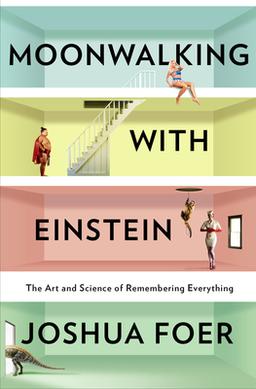
Moonwalking with Einstein by Joshua Foer

Posted by Anonymous


Reviewed by: José Beltrán

What I Read: Moonwalking with Einstein: The Art and Science of Remembering Everything by Joshua Foer

Find It @YCLD: Here!

What It's About:  Joshua Foer is a freelance science journalist  who won the U.S. Memory Championship in 2006, then represented 300 million US citizens at the World Memory Championship. Foer won 13th place out of 37 world competitors. Most importantly for Foer, he joined the KL7 Club: the world’s most esteemed organization of mental athletes. He trained himself using the loci (Latin word for places) system of memorization using what he called memory palaces. The Loci system is attributed to Simonides of Ceos (c.560 B.C.) who is credited with turning words into mind pictures. To use this system, compress as much information as possible into a single well-formed image. Use your creativity to imagine the most ludicrous, most raunchy, most hilarious, most unforgettable images. Remember not word by word but rather topic by topic, picture by picture.

One of the techniques is to use the number n to stand for the number 2, then use a picture of a nun to remember the number 22. A quote worth quoting: “Regular practice simply isn’t enough. To improve, we must watch ourselves fail, and learn from our mistakes.” His most quotable quote was “Our memories make us who we are. They are the seat of our values and source of our character.” This book is so vital that its author was invited to give a TED (Technology, Entertainment and Design) talk on it. (It is available on youtube.com).

What I Thought: Use it or lose it! “The human brain is estimated to be able to store 108432 bits; there are only about 1078 atoms in the observable universe.” In Greek Mythology, Memory is the mother of the Muses. Without memory how could there be music, art, history, literature or science? How could there be us, our loved ones? Before writing the only way to record anything was through sheer memory. Poetry was created to help people remember through rhyme and meter. Writing was our next crutch, but look at all the irretrievable literature that has been lost. It is important to stop and smell the roses, but to truly live a memorable life we have to remember to remember smelling the roses.


We are nearing the crossroad, with all our electronic memory outsourcing we are forgetting how to remember. We are externalizing, outsourcing our memory. Why bother remembering? Just tap it into the computer, the phone, the tablet. Ray Kurzweil, one of the most respected advocates of the role of technology in our future, estimates the singularity point, the year 2045, is when mankind takes the next step in evolution into a part human, part machine.

Foer laments that people no longer invest in their memory. Our minds have incredible memory capacities. However, in spite of all the memory stunts and winning the US Memory Championship, Foer’s Working Memory was not improved. Josh not only forgot his keys, he forgot his car and even where he had parked it. If we do not pay attention, if we are not deeply engaged, fully mindful, we will not be able to recall where we put our keys. We are constantly bombarded with distractions. Our memory will only work when we remember to stop being on autopilot, notice, and pay attention. We are too distracted to remember to remember. Remember: “practice makes perfect.”  To remember where you put your keys takes concentrated, self-conscious, deliberate will power and practice.

Readalikes: Your Memory: How It Works & How To Improve It by Kenneth L. Higbee, Ph.D.; The Memory Prescription by Gary Small, M.D. 

Or look this book up on NoveList!

Wednesday, August 12, 2015

The Book That Changed My Life by Roxanne J. Coady & Joy Johannesson, eds.

Posted by Anonymous


Reviewed by: José Beltrán

What I Read: The Book That Changed My Life by Roxanne J. Coady & Joy Johannesson, eds.

Find It @YCLD: Here!


What it’s About: The editors selected 72 authors' short essays about what book they themselves love that changed their lives and ultimately inspired them to become famous authors in their own right. The editors' Read to Grow Foundation is a 100% donor-supported nonprofit organization that distributes free books through volunteers to the needy. Roxanne J. Coady won the Publishers Weekly Bookseller of the Year Award in 1995.

What I Thought: These essays cover the gamut of book publishing. There are so many quotable passages in these essays from all walks of life. You should read it just to select your own favorite quotes. Not only did I come away with many quotes, but a large list of books to read, both by these authors, and yes, from their favorite authors too.

The touching, moving “I Think I Can” about The Little Engine That Could: Jeff Benedict recalls the many lessons his single mom taught him from the stories she read to him each night.

Robert Ballard, deep-sea explorer and bestselling author on the Titanic: the reason for being, raison d’être, is not the view at the end, but the act of becoming. “Life is the act of becoming.” He is the founder of the Jason Project to mentor middle school students by scientists from NASA, NOAA, DOE, and the National Geographic Society.

“You could read the same text repeatedly over time, and something fresh and new would declare itself with each reading”: Nichikas A. Basbanes on Shakespeare.

Chris Bhojalian: “I learned the comfort that can be taken from the pages of a book, and the friendship that can be found in a story.”

Da Chen, Chinese peasant to Wall Street Investment Banker, wrote “I write because my heart demands so.”

Patricia Cornwell wrote on her ancestor Harriet Beecher Stowe’s Uncle Tom’s Cabin: “The original sin: the abuse of power, the ultimate result which is enslavement, impoverishment, suffering, and death."

Cuban exile Carlos Eire wrote: “Books have made me who I am". Carlos recommends three Spanish books: Tres tristes tigresCien años de soledad, and Imitación De Cristo.

Robert Kurson wrote of Denial of Death by Ernest Becker: "…started reading. By the time I got up, I viewed the world differently, by the time I got up, I was a different person."

Yes, politicians do read! Senator Joe Lieberman: “Every time you read and learn …your life is changed dramatically over time as you continue learning and thinking." Senator John McCain wrote “For Whom the Bell Tolls is full of adventure, and fighting and romance…"

Sherwin B. Nuland: “Books are actually the stuff of which dreams are made.”

Frenchman, Jacques Pepin wrote of The Myth of Sisyphus by Albert Camus:  “We must be responsible for our actions.”

Ian Rankin:  “There was no rating on books, anybody could read anything.”

Lisa Scottoline: “Every book I read changes me in some way… and that’s why books matter. Lisa on “Angela’s Ashes” It breaks your heart and puts it back together again, but better”

Liz Smith on Voltaire: "I began to question and seek".

Michael Stern as a country boy was transported to unknown worlds by the Sears catalogue.

Frank McCourt tastes the words from Shakespeare's Henry VIII:  "It's like having jewels in my mouth when I say the words."

Readalikes: You've Got To Read This Book! by Jack Canfield, ed.

Or look this book up on NoveList!
Thursday, July 2, 2015

The Death of Money by James Rickards

Posted by Anonymous


Reviewed by: José Beltrán

What I ReadThe Death of Money by James Rickards

Find It @YCLD: Here!

What it’s About:  Mr. James Rickards is a seasoned financial counselor, investment banker and risk manager with over thirty years’ experience in capital markets including all aspects of portfolio management, risk management, product structure, financing, regulation and operations. Mr. Rickards' market experience is focused in alternative investing and derivatives in global markets. He is also the CIA’s Financial Threat & Asymmetric Warfare Advisor. He knows of what he speaks. Rickards warns of an imminent USA $100 trillion collapse. This Economic Alarmist takes us behind the conspiratorial scenes of current global currency wars, as only he can, he certainly has connections. Rickards says, “The US government has secretly set up a “Day After Plan” after the collapse of the dollar.” The US dollar has three strikes lined up against it. The Catastrophic triple whammy of Economic Bubbles about to burst: the Stock Market, Bond Marketand the Derivatives Market. James Rickards is also the author of Currency Wars: The Making of the Next Global Crisis,  published by Penguin/Portfolio, November 2011.

What I Thought: Rickards leaves the reader with no doubt about his worldwide financial credentials, nor his knowledge of economic theory e.g. “If (R +I) –B> [T-S] then US deficits are sustainable, Conversely if (R+I) –B <[T-S] then US deficits are not sustainable.” Rickards does not limit the scope of this book to the US, but has personal extensive experience and knowledge of the World Economic stage. Unlike the CIA World Fact Book’s dry statistical approach, Rickards minces no words. “The Russian economy is best understood as a natural resource extraction racket run by oligarchs and politicians who skim enormous amounts off the top and reinvest just enough to keep the game going.” He goes into great financial, historical detail, intelligence and analysis in his chapters on China’s New Financial Warlords, the New German Reich, and the BRICS (Brazil, Russia, India, China, South Africa) and even the BELLs(Bulgaria, Estonia (Skype), Latvia, and Lithuania).

The book includes extensive scholarly notes, internet addresses, and selected sources. All world economies from ancient times have competed for World Domination through the manipulation of their own and others currency. Ancient Rome, Argentina, and now the US, China, not to the exclusion of other countries, debase their currencies to make their products cheaper to other countries. Mark Twain said that Truth is stranger than fiction, because Fiction is obliged to stick to possibilities; Truth isn't.' The world banks are gambling with inflated paper money(debt) on the gaming tables of the World,US$200 trillion Stocks, US$100 trillion Bonds and US$693 trillion Derivatives. Please compare this US$993 trillion alone in debt to the measly paltry global GDP of only US$73.48 trillion dollars. Somehow countries managed to increase the global debt to GDP from 218 percent in 2000 to 266 percent in 2010.

Rickards goes to great lengths to show how external terrorists could set up terrorist financial cells to destroy the US market. Fake paper wealth debases real wealth. The author points out that the Debt /GDP (Gross Domestic Product) ratio of the United States is over the total worth of the country by about 101, not to worry, Japan’s Debt/GDP  is 243.2% of GDP and is still one of the 5 World Central Banks. Rickards is not a survivalist telling us to head for the hills.

This subject is deadly serious! However, Rickards offers an unrealistic laughable survival plan! US tourists have been caught abroad, when dollars were useless, they had to resort to bartering their jewelry. What average person can hold thousands of dollars in 20% gold, 20 % undeveloped land, 10% museum quality fine art paintings(Remington paintings?), 20% alternative private equity funds, and last but not least 30% cash. If dollars becomes as worthless as confederate dollars, not worth the paper they are printed on and lawlessness reigns supreme, might I recommend instead of a Frederic Sackrider Remington painting, a pump action Remington. This is a must read book for its rare glimpse into the naked truth of world economics.

Readalikes: Currency Wars: The Making of the Next Global Crisis by James Rickards


Or look this book up on NoveList!